
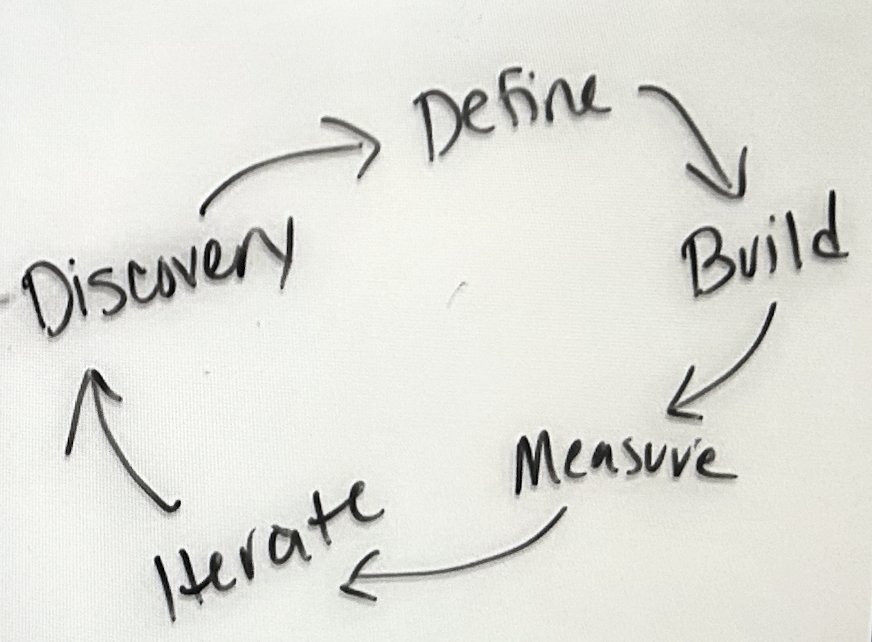
When joining a new line of business as the head of product design and brand, I quickly discovered that the team was only executing on the work and not being fully leveraged. I led the effort to determine how the design team could evolve beyond the “Build” phase and take some level of ownership within each phase of the product development lifecycle.
- Discovery
- Define
- Build
- Measure
- Iterate
Level setting and team principles
As a new leader to the team, the first steps I took were to build trust, establish common team principles and push the team’s thinking on how they worked and what their role was as design on the team.
I led a hopes and fears session with the team to discuss what they hoped they could say we accomplished by the end of the year and what they were afraid would hinder them from being able to accomplish those outcomes. Each individual would put their thoughts on individual sticky notes and then share with the team.
As the team shared out their hopes and fears with each other, they realized that they were more aligned then unaligned. This discussion helped the team feel confident in me as a leader, but also help build trust and encourage candor with each other.
After the session, I took the notes and synthesized the themes to establish team principles. I shared the principles back with the team and made some updates. These principles were kept in a common space in the office as well as being pinned to our team slack channel. I also shared the principles with our senior cross functional leadership team.

Discovery
When I joined the team, most of the work being done started with a creative brief written by a product manager with build requirements for design. I challenged the team to take meaningful steps to consistently gather customer feedback to enable them to inform the design and product decisions being made vs. being dependent on the product managers to write requirements.
At first, this was met with some resistance. The team felt like I was asking them to do more work and didn’t see the benefit. I helped the team understand the full product development lifecycle and why design should be a part of every stage, why that would elevate the quality of the work and change how they would be leveraged as design.
The team implemented a monthly focus group with call center agents and quickly realized that obtaining feedback consistently was helping them elevate the quality of the work and have better backing for their design decisions when presenting the work to stakeholders.
Over time, the team expanded their discovery efforts to include conducting research via usertesting.com and conducting empathy interviews directly with customers.
Define
Prior to joining the team, design was not being included in roadmap planning and prioritization activities. I took steps to bring the design team into the planning sessions. I worked with the team to train them up on how to facilitate workshops and craft a product vision in partnership with their cross functional partners. Once the team had set a vision with their partners, they were able to effectively determine their own priorities and establish their own processes to start taking meaningful steps towards achieving that vision. This new way of working led to design owning intent, in addition to receiving intent from product.
Build
When it came to the build phase, the team was already effective in this area, so I focused more on improving vs. revamping. I implemented cross functional design reviews to enable alignment with stakeholders and ensure I was consistently providing feedback on the work. This made the build process significantly more efficient and decreased rework substantially.
Measure
I meet with the Business Analysts leaders to establish a working relationship. I started inviting the BA’s to our planning sessions with the intent of gaining better awareness of the data and broadening our understanding of what the business was tracking as success metrics. I gave the BA’s action items for each planning session to provide the team with the month over month metrics. This ensured that all the teams involved in planning had awareness of the data, what was being tracked and why. This new way of working created a platform to push and pull on the metrics being tracked, which further deepened the working relationships between design and the business.
Iterate
Now that the design team was conducting research and had visibility to the data metrics, they were able to more effectively iterate on their design work. I guided the team to effectively balance qualitative and quantitative data in addition to balancing experience quality with tech constraints and the needs of the business.

Results
- The following year, I was leading the conversation when it came to experience quality with the executive team as head of design (this was previously been led by product).
- Research was being conducted consistently and design was looped in to share research insights in the monthly business review with the executive team.
- Design was being engaged in strategic conversations and was being looped in to discuss success metrics.
- Design had direct ownership of key initiatives the following year.
- Design had access to success metrics and a healthy working relationship with the business.
- The cross functional team was able to make informed iterations on the designs and the product.
- 2 of my directs were promoted.